On-water rowing drills and sessions Every stroke a little better.
Six drills with their purpose, session types from steady state to race simulation, and how to measure rate and split without fooling yourself.
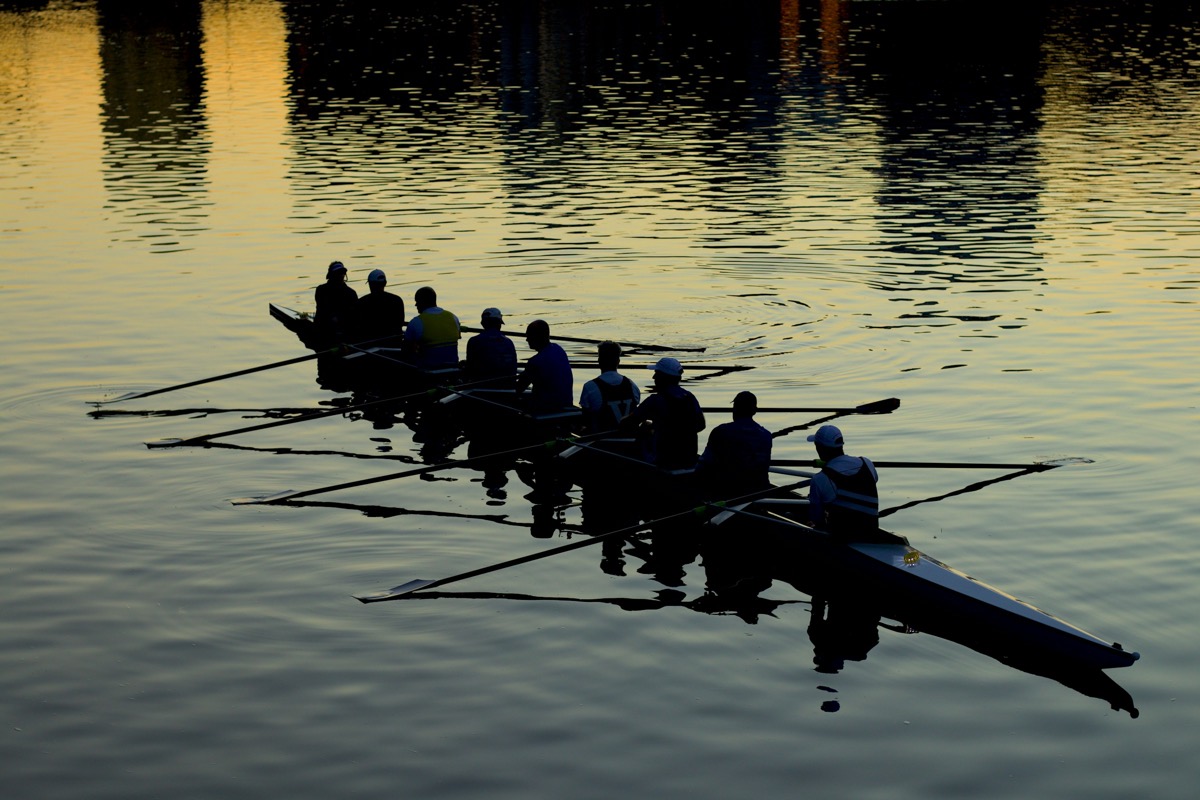
Photo: Mitchell Luo on Unsplash
Most rowing happens on the water, and that is where there is the most to gain. A water session usually has two parts: technique while you are still fresh, and then a session type in one of the zones you also know from the erg.
Technique first
A drill cuts the stroke into pieces, lets you practise them separately and then puts them back together into the whole stroke. The World Rowing coaching handbook puts technical drills early in the session, before fatigue affects your concentration [1]. Concept2 and British Rowing describe the same kind of exercises [2, 3].
A drill only works if you know what it is for. Coach Hollings puts it briefly: "Don't do drills blindly" [4]. That is why every drill below comes with its purpose. To be honest: there is hardly any evidence that a particular drill makes the boat faster. What follows is coaching practice.
Six technique drills
Pause drill
Purpose: sequence and balance. Are you ready before you start to slide? Row easy at rate 18 and stop for 1 count after the drive at a fixed point: hands away, body over or half slide. Do it every other stroke or every stroke. Watch for a slumped posture in the pause and a blade dragging on the water. Bring body and arms forward together, not with stiff arms.
Pick drill: arms only, then build up
Purpose: the sequence of the stroke, legs, trunk, arms, and the reverse on the recovery. Row 10 strokes with arms only, 10 with arms and body, then add quarter, half and full slide. With arms only, the trunk stays still and the shoulders stay low.
Finishes
Purpose: a clean, round finish. Row with arms and a little body, keep the blade buried to the end, then tap down and feather. Common faults: taking the blade out too early, or leaning too far back.
Square blades
Purpose: blade height and balance on the recovery. The blade stays square through the whole stroke and recovery. If it touches the water, your hands are too low or the boat is down. Keep it short: one coach warns that square blade rowing can teach you to wash out at the finish [4].
Feet out
Purpose: a controlled finish. Take your feet out of the shoes or undo the straps and row with your feet resting on the footplate. If you come off the footplate, you are yanking at the finish or leaning back too far.
One side rowing
Purpose: feel for your own blade while the others balance the boat. Bow side rows, stroke side balances with the blades flat on the water, then switch. In a single, do it briefly with one oar on the water. The balancing side doesn't press the blades into the water.
Session types on the water
On the water you use the same five zones as on the erg: UT2, UT1, AT, TR and AN. Work and rest per zone follow the Concept2 training guide [5]; the session types come from the FISA club programme [6] and the World Rowing handbook [1].
Steady state
UT2 at rate 18 to 20, 45 to 90 minutes in pieces of 15 to 30 minutes, there and back, with 1 to 2 minutes to turn. Hard steady state in UT1 is 3 to 4 x 10 to 15 minutes at rate 20 to 22, with 3 to 5 minutes rest.
Threshold
AT at rate 22 to 26: 3 to 4 x 8 minutes with 2 to 3 minutes rest. The World Rowing handbook gives 4 x 8 minutes at rate 22 to 24 [1].
30/10
Race pace in small portions: 30 strokes on at rate 30 to 34, then 10 strokes light, 8 to 10 times in a row. Do 2 to 3 sets with 4 to 5 minutes rest in between.
Race simulation
1000, 500, 250 and 250 metres at rate 30, 32, 34 and as high as it goes, 2 to 3 times, with 4 to 5 minutes rest. Advanced crews also row 2000 metres with rate steps from 30 to 36.
The FISA programme gives a rate range per session type: the low end for slow boats such as the single, the high end for fast ones such as the eight. Into a headwind and against the stream you row lower [6]. Beginners row shorter pieces, keep the rate up to 24 and do drills in a stable boat.
Measuring rate and split
On the water, rate says little about how hard you work. In Australian elite rowers, the average rates of the heart rate zones were only 1 to 4 strokes apart, with a lot of overlap [7]. So steer a water session on rate, feel and heart rate together, not on a target split from the erg.
Counting rate without a meter
Time three strokes, from catch to catch. Your rate is 180 divided by that time in seconds: three strokes in 9 seconds is rate 20. Over a whole piece, take 60 x the number of strokes divided by the time in seconds.
Average split and distance per stroke
Never average your splits. Row 30 seconds at a 2:05 split and 30 seconds at 1:40, and the average of those splits is 1:52.5. But you rowed 270 metres in 60 seconds, so your real split is 500 x 60 / 270 = 1:51.1. Always use total time and total distance. Distance per stroke is distance divided by strokes: 1000 metres in 4:30 with 90 strokes is rate 20, a 2:15 split and 11.1 metres per stroke.
Wind and stream
GPS measures over the ground, not through the water. You remove most of the stream by rowing a piece there and back. A worked example: a boat doing 3.5 metres per second, with a stream of 0.3 metres per second. One way, that changes the split by 12 to 13 seconds; there and back together, by about 1 second. Wind can't be removed fairly: there is no standard way to measure it [8]. So only compare pieces on the same water, in roughly the same weather.
Safe on the water
Your club's rules always come first. Cold water is the biggest danger: cold shock in the first minute is more dangerous than hypothermia [9]. The Dutch rowing federation KNRB asks for clearly visible clothing, advises against going out in the dark, at dusk or in fog, and advises looking ahead and behind you regularly [10].
Read on
- Erg training plan: the five zones from your 2k, with example workouts.
- Strength training for rowers: strength work in the gym alongside the water, in three phases.
- Race preparation: working back from your race, recovery weeks and the taper.
- Rowing Buddy: the app for club rowers, on land and on the water.
This session in the boat.
In Rowing Buddy these drills and session types are in a library. In the boat the session runs along on your phone, and afterwards you see your time, split and rate for every piece. A coach can set a water session for the whole crew, and you link a file from your NK SpeedCoach or watch to your session. The exercises are being reviewed by club coaches with the Dutch Roeicoach 3 and 4 qualifications.
What this rests on.
- 1. coaching handbookNilsen TS, Daigneault T, Smith M (eds). The FISA Coaching Development Programme: Handbook, Level II. FISA, 2002. worldrowing.com (pdf)
- 2. drillsConcept2. Rowing Drills. concept2.com/training/rowing-drills
- 3. drillsBritish Rowing. Rowing Exercises. britishrowing.org
- 4. drills with a purposeHollings C. Technique feature: do drills with purpose. row2k, 2018. row2k.com
- 5. zonesO'Neill T, Skelton A. Indoor Rowing Training Guide, version 2. Concept 2 Ltd. Copy at Leicester Rowing Club (pdf)
- 6. club programmeNilsen TS. FISA Development Program: Training Program for Clubs and Individuals. FISA, 2009. Copy at the Czech Rowing Federation (pdf)
- 7. rate on the waterWatts SP et al. Exploring the depths of on-water training in highly-trained rowing athletes. Eur J Sport Sci, 2024. doi.org/10.1002/ejsc.12069
- 8. measuring on the waterBinnie MJ et al. Quantifying on-water performance in rowing: a perspective on current challenges and future directions. Front Sports Act Living, 2023. doi.org/10.3389/fspor.2023.1101654
- 9. cold waterBritish Rowing. RowSafe 2026, chapter on cold water and hypothermia. britishrowing.org (pdf)
- 10. safe rowingKNRB. 10 tips voor veilig roeien (in Dutch). knrb.nl
Coaching sources such as the FISA and Concept2 handbooks carry weight in rowing, but they are not peer reviewed. The worked examples are plain arithmetic. This page is general information, not personal advice.