Strength training for rowers Strong on land, fast on the water.
Two sessions a week alongside your rowing. How to build strength without hurting your water training, and what the research says.
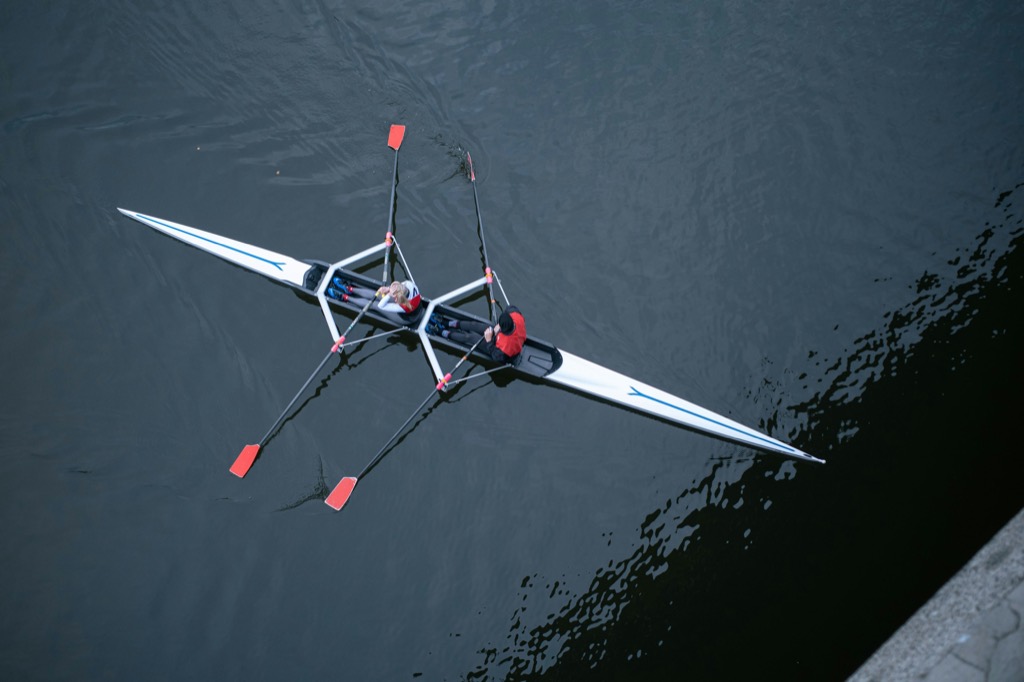
Photo: Josef Stepanek on Unsplash
A stroke starts with your legs against the footplate. The more force you can apply there, and the better you pass it on through your trunk and arms, the more the boat gets out of it. That is why strength work in the gym is a fixed part of the winter for many rowers. On this page you read why it works, how often to train, how to build twelve weeks and why you never go to failure.
Why strength training for rowers
The effect is real, but modest. A meta-analysis of recreational, sub-elite and elite rowers found small but clear effects of strength training on leg strength and on rowing performance [1]. So don't expect extra seconds per 500 metres after a few weeks; expect a stronger base under your stroke.
A review on strength in rowers advises doing most of the strength work in the preparation period, and early in the week [2]. The FISA club programme puts heavy strength work in the preparation period, from October to February, two to three times a week. In the racing season one session a week remains to maintain strength, and the water comes first [3].
How often: twice a week
For most club rowers, two strength sessions a week alongside the water is realistic. It is also enough: strength already improves with two sessions a week [4]. Leave at least one day between two sessions, so your legs are fresh enough for the water.
A session of 50 to 75 minutes has four parts: a warm-up with mobility, the strength work, a short erg block and stretching. That way you combine strength and endurance in one evening, in a fixed order.
Twelve weeks in three phases
A common structure is three blocks of four weeks: three weeks building up, then a lighter week. That wave pattern, load going up and then briefly down to recover, is in the World Rowing coaching handbook [5], and the Concept2 training guide uses the same rhythm [6].
| Phase | Sets x reps | Reps in reserve |
|---|---|---|
| Base, weeks 1 to 4 | 2 to 3 x 10 to 12 | 4, then 3, then 2 |
| Strength, weeks 5 to 8 | 3 to 4 x 6 to 10 | 3, then 2 |
| Strength and power, weeks 9 to 12 | 4 x 4 to 6 | 2 to 1 |
Base: learning the movements
In the first four weeks you learn the exercises and let your body get used to them. Many reps with a light weight, and plenty of reps in reserve. Think of the goblet squat, the Romanian deadlift with dumbbells and the one-arm row. Hip exercises may go up to 15 reps.
Strength: heavier with fewer reps
In weeks 5 to 8 the weight goes up and the reps come down. The exercises get harder: from the goblet squat to the Bulgarian split squat, or the leg press if your club has one, and from the dumbbell deadlift to the barbell.
Strength and power: a hard drive
In the last block you turn strength into speed. On the main lifts you do 4 sets of 4 to 6 reps. Only now do explosive exercises come in, such as the kettlebell swing, the squat jump and power strokes on the erg: few reps, at full speed. The deadlift from the floor also waits until this block.
Deload weeks and tests
Weeks 4 and 8 are light weeks: the same exercises and the same weight, but about half the sets and reps, with 4 reps in reserve. Coaches agreed on such a week, with less volume and the same weight, in a consensus study [7]. Start the block with a test, for example a 6-minute test on the erg and a reps test on the goblet squat, and repeat the same tests in week 12. Then the comparison is fair.
Which periodisation model works best for strength is not settled: linear and undulating models worked equally well in a meta-analysis [8]. Periodising helps; the exact model matters less.
Never to failure
Every set comes with a number of reps you should still have left. Coaches call this RIR, reps in reserve. With RIR 2 you stop when you could have done two more. In the whole plan above you never go to the point where the weight won't move.
There is a good reason for that. In 43 trained rowers doing strength work alongside their endurance training, strength training not to failure gave better results than training to failure [9]. Training to failure costs a lot of recovery, and you need that recovery for the water.
You get heavier with double progression. When you reach the top of the rep range in all sets, with the required reps in reserve, you go one step heavier next time. If not, you stay at the same weight.
Strength before the erg
A lot of endurance training can slow your strength gains. The effect grows with how often and how long you do endurance work [10]. A more recent meta-analysis found no brake on maximal strength and muscle size, but possibly on explosive power [11].
For rowers and canoeists the advice comes down to the same thing: few sets with heavy loads, not to failure, strength before endurance, and enough recovery in between [12]. If you do strength and erg on the same evening, start with strength and row afterwards.
What a plan doesn't know
A general plan doesn't know your racing calendar, or how hard you trained on the water that week. After a hard water session, choose the light option or move everything back a day. Before a race you cut the volume and keep the intensity high. How to work back from your race and how long the taper should be is on the race preparation page. Junior rowers, beginners, masters and rowers with an injury are best off having their club coach adjust the plan.
Read on
- Erg training plan: five zones from your 2k and a progression of 24 erg sessions.
- On-water training and drills: drills, session types and how to measure rate and split.
- Race preparation: working back from your race, recovery weeks and the taper.
- Rowing Buddy: the app with this strength plan for club rowers.
This plan on your phone.
Rowing Buddy follows exactly this structure: twelve weeks with session A and B, light weeks in weeks 4 and 8, and tests at the start and the end. You log your sets in the gym and the app works out your next weight.
What this rests on.
- 1. strength and rowingThiele D, Prieske O, Chaabene H, Granacher U. Effects of strength training on physical fitness and sport-specific performance in recreational, sub-elite, and elite rowers. J Sports Sci, 2020. doi.org/10.1080/02640414.2020.1745502
- 2. strength in rowersLawton TW, Cronin JB, McGuigan MR. Strength testing and training of rowers: a review. Sports Med, 2011. ro.ecu.edu.au/ecuworks2011/104
- 3. club programmeNilsen TS. FISA Development Program: Training Program for Clubs and Individuals. FISA, 2009. Copy at the Czech Rowing Federation (pdf)
- 4. resistance trainingCurrier BS et al. ACSM Position Stand: resistance training prescription for muscle function, hypertrophy, and physical performance in healthy adults. Med Sci Sports Exerc, 2026. doi.org/10.1249/MSS.0000000000003897
- 5. periodisationNilsen TS, Daigneault T, Smith M (eds). The FISA Coaching Development Programme: Handbook, Level II. FISA, 2002, chapter 4.3. worldrowing.com (pdf)
- 6. training guideO'Neill T, Skelton A. Indoor Rowing Training Guide, version 2. Concept 2 Ltd. Copy at Leicester Rowing Club (pdf)
- 7. deload weeksBell L et al. Integrating deloading into strength and physique sports training programmes: an international Delphi consensus approach. Sports Med Open, 2023. doi.org/10.1186/s40798-023-00633-0
- 8. linear or undulatingHarries SK, Lubans DR, Callister R. Systematic review and meta-analysis of linear and undulating periodized resistance training programs on muscular strength. J Strength Cond Res, 2015. pubmed.ncbi.nlm.nih.gov/25268290
- 9. not to failureIzquierdo-Gabarren M et al. Concurrent endurance and strength training not to failure optimizes performance gains. Med Sci Sports Exerc, 2010. doi.org/10.1249/MSS.0b013e3181c67eec
- 10. concurrent trainingWilson JM et al. Concurrent training: a meta-analysis examining interference of aerobic and resistance exercises. J Strength Cond Res, 2012. doi.org/10.1519/JSC.0b013e31823a3e2d
- 11. concurrent trainingSchumann M et al. Compatibility of concurrent aerobic and strength training for skeletal muscle size and function: an updated systematic review and meta-analysis. Sports Med, 2022. researchonline.jcu.edu.au (pdf)
- 12. rowing and canoeingGarcía-Pallarés J, Izquierdo M. Strategies to optimize concurrent training of strength and aerobic fitness for rowing and canoeing. Sports Med, 2011. pubmed.ncbi.nlm.nih.gov/21425890
Coaching sources such as the FISA and Concept2 handbooks carry weight in rowing, but they are not peer reviewed. This page is general information, not personal advice.