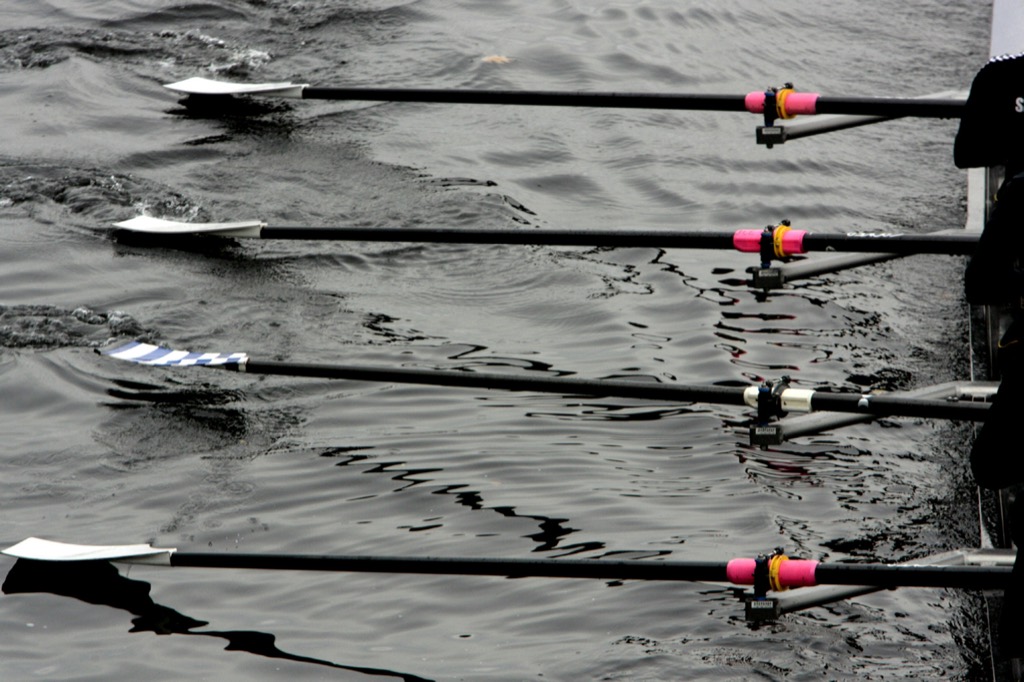
Race preparation for rowers Fresh and sharp on the start.
Work back from your race, build up in phases with recovery weeks, and taper without losing your edge. This is what the research says.
Photo: David Trinks on Unsplash
A race is on a fixed day. If you want to be at your best there, you don't just train hard, you train hard at the right time, and less at the right time. On this page you read how to work a plan back from your race, how to split it into phases, where the recovery weeks go, how to taper and how to keep track of how hard you train.
Work back from the race
The World Rowing coaching manual describes periodisation as dividing the training year so that you peak at the right moment for the most important race. You make the plan in reverse order, starting from the date of that race [1]. Recent literature on periodisation also starts from a plan that is built towards a competition [2].
In practice you put the race date on the calendar first and count back. Right before the race comes the taper. Before that is the phase in which you train most race-specifically, before that the build-up of strength and threshold, and at the very front the base. That way you know the goal of every week, and your hardest week doesn't land right before the start by accident.
Phases with one goal
Issurin describes blocks that each have one main goal: first build capacity, then turn it into more specific forms, and finally show your form at the moment it counts [3]. The World Rowing manual counts four to eight weeks for such a cycle [1]. For a club rower with a preparation of three to four months, that could look like this:
| Phase | Goal | On the water and the erg |
|---|---|---|
| Base | Easy volume and learning the exercises well | Lots of steady state, technique |
| Strength | Lifting heavier with fewer reps | Hard steady state and threshold work |
| Power | Turning strength into a fast drive | Starts, pieces at race pace, race simulation |
| Taper | Losing fatigue, keeping sharpness | Fewer minutes, short pieces at race pace |
If you have less time, shorten the base first. Keep the taper and the phase before it as intact as you can, because they sit closest to the race. One caveat belongs here: many rules about periodisation come from tradition and experience rather than hard evidence [4]. Use a phase plan as a guide, not as law.
Recovery weeks
Load goes up and then briefly down to recover: that wave pattern is in the World Rowing manual [1], and the Concept2 training guide also uses a lighter fourth week [5]. A common rhythm is three building weeks and then a recovery week, in the base possibly four. Coaches agreed in a consensus study on a light week with less volume and the same weight [6].
A recovery week means fewer minutes, not sitting still. Keep a few short pieces at race pace, so your rhythm and sharpness don't fade. Don't plan a recovery week right before the taper: the taper itself already takes the fatigue away [7].
The taper
In the taper you cash in the work of the weeks before. A meta-analysis of 27 studies found the best effect with a taper of about two weeks, in which volume went down by 41 to 60 percent, gradually and not in one step. Intensity and the number of sessions stayed the same [7]. A review mentions tapers of 4 to 28 days and a gain of around 3 percent [8]. That intensity must stay high while volume can come down a lot is something Mujika also shows in a later overview [9].
The harder you trained before, the longer the taper may be [10]. If you only train a few times a week, you build up less fatigue and a shorter taper is enough. Rowing Buddy uses this rule of thumb for it. It is an assumption of the app within what the research shows, not the result of a study:
| Sessions a week | Taper |
|---|---|
| 1 to 3 | Just the race week |
| 4 to 6 | Ten days |
| 7 | Two weeks |
In the taper you train shorter, not less often. Every session keeps a few short pieces at race pace. For strength, a smaller volume at the same or a slightly higher weight works best, and a few days without any strength work can still raise your maximal strength a little [11]. So do your last heavy strength session a few days before the race; Rowing Buddy keeps it to four days before at the latest.
The FISA club programme gives a shape for a week with a regatta: steady state early in the week, once 1000 and 500 metres at race pace in the middle of the week, and the last days short and easy [12]. The day before the race you row short, with a few starts and short pieces at race pace. On race day itself you only do your warm-up and your usual routine.
Many rowers get restless in the taper and want to add training. Don't. Fewer minutes with the same sharpness is exactly the point, and in those weeks rest is the work.
A, B and C races
Not every race matters equally. Give them a priority, so you know what you taper for and what you train through.
- An A race is your main goal. You plan towards it, with a full taper.
- A B race matters, but you train through it. The week stays lighter and the last two to three days before it are short and light.
- A C race you just enter, or you row it as a hard session. The day before is short.
Count every race as a hard session. Good endurance athletes do most of their training easy and only a small part hard [13]. If there is a race in your week, drop the hardest planned session.
Two important races close together are difficult. Almost all research on peaking is about a single peak, and little is known about several peaks [14]. Choose which one matters most, and make the other a B race.
How hard do you train? Session RPE
To know whether you build up and taper as intended, you need to count your load, also on the water where you have no power meter. The simplest measure is Foster's session RPE: about half an hour after the session you give a number from 0 (rest) to 10 (maximal) for how hard the session was as a whole. That number times the duration in minutes is the load [15].
| Session | Minutes | RPE | Load |
|---|---|---|---|
| On the water, 3 x 10 minutes hard steady state | 75 | 4 | 300 |
| Strength session | 60 | 6 | 360 |
| Erg session at threshold | 45 | 7 | 315 |
| Week | 180 | 975 |
A review of 36 studies found the method valid and reliable, across many sports and levels [16]. In rowers, session RPE rose during a hard block while the heart rate zones stayed the same, and it tracked fatigue better than heart rate [17]. In top rowers it worked best on the erg and less well for strength [18].
A talk test helps you score honestly. Up to a 3 you talk in full sentences, at 4 to 6 in short sentences, and from a 7 only single words come out. Only compare your numbers with yourself, because everyone uses the scale differently. And don't expect it to predict injuries: the well-known sum of last week's load against the last four weeks has fundamental problems [19].
Ill, or missed weeks
Don't make up for missed sessions. Catching up makes the next week too hard, and then you start the next block tired. Get back in where your plan stands now, first with a lighter week to come back and then a few weeks with a slightly lower load. Your race date doesn't move, so the part you missed drops out.
Don't train with a fever. If you are unsure whether you can train again, ask your doctor.
What a plan doesn't know
A plan doesn't know your crew, or how hard today's session in the boat was. Your coach decides the crew order, who races and whether you are fit enough after illness. Junior rowers, masters and rowers with an injury are best off having their club coach adjust a plan.
Read on
- Strength training for rowers: how often, three phases of four weeks and why you never train to failure.
- Erg training plan: five zones from your 2k and a progression of 24 erg sessions.
- On-water training and drills: drills, session types and how to measure rate and split.
- Rowing Buddy: the app that works your plan back from your race.
Your plan to the start.
Put your race in Rowing Buddy and the app works your plan back: base, strength, power and taper, with recovery weeks, split over strength, erg and water. After every session you tap how hard it was, and when things go differently than planned you adjust without your log changing. The set-up was reviewed by a club coach.
What this rests on.
- 1. periodisationNilsen TS, Daigneault T, Smith M (eds). The FISA Coaching Development Programme: Handbook, Level II. FISA, 2002, chapters 4.3 and 4.4. worldrowing.com (pdf)
- 2. periodisationMujika I, Halson S, Burke LM, Balagué G, Farrow D. An integrated, multifactorial approach to periodization for optimal performance in individual and team sports. Int J Sports Physiol Perform, 2018. doi.org/10.1123/ijspp.2018-0093
- 3. blocksIssurin VB. New horizons for the methodology and physiology of training periodization. Sports Med, 2010. pubmed.ncbi.nlm.nih.gov/20199119
- 4. caveatKiely J. Periodization paradigms in the 21st century: evidence-led or tradition-driven? Int J Sports Physiol Perform, 2012. pure.ul.ie
- 5. training guideO'Neill T, Skelton A. Indoor Rowing Training Guide, version 2. Concept 2 Ltd. Copy at Leicester Rowing Club (pdf)
- 6. light weeksBell L et al. Integrating deloading into strength and physique sports training programmes: an international Delphi consensus approach. Sports Med Open, 2023. doi.org/10.1186/s40798-023-00633-0
- 7. taperBosquet L, Montpetit J, Arvisais D, Mujika I. Effects of tapering on performance: a meta-analysis. Med Sci Sports Exerc, 2007. pubmed.ncbi.nlm.nih.gov/17762369
- 8. taperMujika I, Padilla S. Scientific bases for precompetition tapering strategies. Med Sci Sports Exerc, 2003. pubmed.ncbi.nlm.nih.gov/12840640
- 9. intensityMujika I. Intense training: the key to optimal performance before and during the taper. Scand J Med Sci Sports, 2010. doi.org/10.1111/j.1600-0838.2010.01189.x
- 10. taper lengthThomas L, Mujika I, Busso T. A model study of optimal training reduction during pre-event taper in elite swimmers. J Sports Sci, 2008. doi.org/10.1080/02640410701716782
- 11. strength in the taperPritchard H, Keogh J, Barnes M, McGuigan M. Effects and mechanisms of tapering in maximizing muscular strength. Strength Cond J, 2015. doi.org/10.1519/SSC.0000000000000125
- 12. club programmeNilsen TS. FISA Development Program: Training Program for Clubs and Individuals. FISA, 2009. Copy at the Czech Rowing Federation (pdf)
- 13. intensitySeiler S. What is best practice for training intensity and duration distribution in endurance athletes? Int J Sports Physiol Perform, 2010. doi.org/10.1123/ijspp.5.3.276
- 14. several peaksPyne DB, Mujika I, Reilly T. Peaking for optimal performance: research limitations and future directions. J Sports Sci, 2009. ehu.eus
- 15. session RPEFoster C, Florhaug JA, Franklin J et al. A new approach to monitoring exercise training. J Strength Cond Res, 2001. paulogentil.com (pdf)
- 16. session RPEHaddad M, Stylianides G, Djaoui L, Dellal A, Chamari K. Session-RPE method for training load monitoring: validity, ecological usefulness, and influencing factors. Front Neurosci, 2017. doi.org/10.3389/fnins.2017.00612
- 17. RPE in rowersPind R et al. Increases in RPE rating predict fatigue accumulation without changes in heart rate zone distribution after 4-week low-intensity high-volume training period in high-level rowers. Front Physiol, 2021. doi.org/10.3389/fphys.2021.735565
- 18. RPE in rowersDai X, Yan J, Bi X. Concurrent validity and reliability of the session rating of perceived exertion scale among high-trained rowers during training sessions. BMC Sports Sci Med Rehabil, 2025. doi.org/10.1186/s13102-025-01247-7
- 19. injuriesImpellizzeri FM, Tenan MS, Kempton T, Novak A, Coutts AJ. Acute:chronic workload ratio: conceptual issues and fundamental pitfalls. Int J Sports Physiol Perform, 2020. opus.lib.uts.edu.au
Coaching sources such as the FISA and Concept2 manuals carry authority in rowing, but they are not peer reviewed. For the articles, mostly the abstract was read. This page is general information, not personal advice.